


DfAM: designing the part for additive manufacturing
Put material only where it is needed
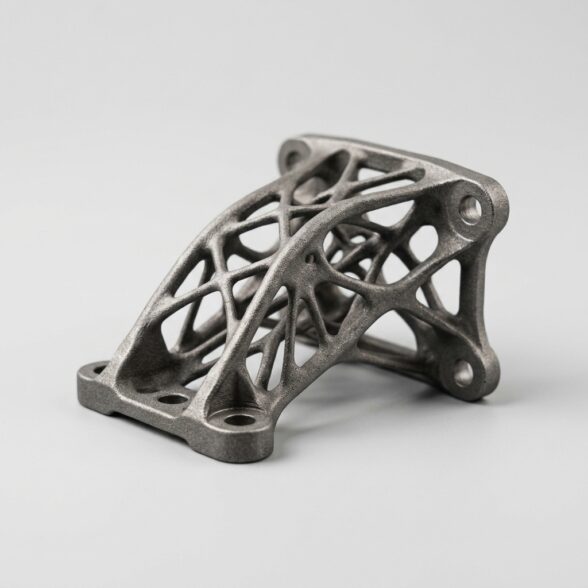
Printing a part designed for machining is usually a mistake, both technically and economically. DfAM (Design for Additive Manufacturing) means redesigning the part for the process that will produce it. Topology optimization is an algorithmic calculation that defines the ideal shape of a part from the loads it actually carries (forces, fixing points), removing every gram of material that does no work.
- Aggressive lightweighting delivers a significant mass saving at equal stiffness, which matters for aerospace, space and moving parts such as robot arms.
- Lattice structures replace solid volume with honeycomb-like micro-structures that absorb impact energy or promote the osseointegration of medical implants.
- Part consolidation replaces an assembly of several bolted components with a single printed monobloc part, cutting the number of references, the assembly time and the leak paths.
Our design office supports you
We are not just printers. Our design office supports you at three levels.
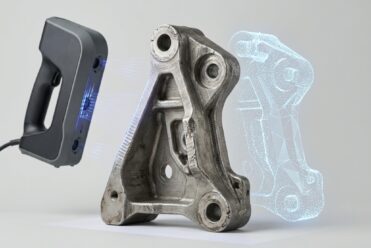
Level 1, auditing what you already have. Analysis of your parts library to identify good candidates for 3D printing and build the business case.
Level 2, iso-functional adaptation. Minor design changes to make the part printable: adding fillets, removing supports, hollowing.
Level 3, full redesign (DfAM). Rethinking the function from a blank sheet to exploit 100% of the potential of 3D, with internal channels and bionic shapes.
Tools and methods
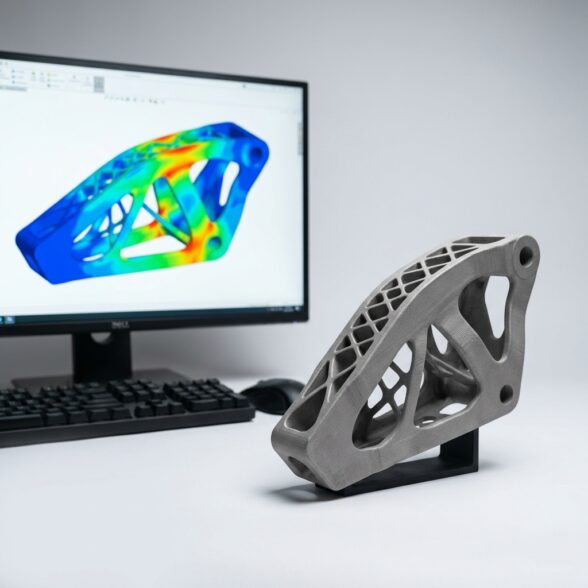
We use industry-leading software suites (Simulia Abaqus and Ansys) to simulate mechanical and thermal loads before printing. Finite element analysis (FEA) confirms that the lightweighted part will withstand real service loads, and process simulation can predict thermal distortion during metal printing so the file is compensated upstream, an anti-warping approach.
Frequently asked questions
No. It is most spectacular in metal (titanium, aluminium) because the material is expensive, but it is just as relevant in polymer (SLS) to save weight on drones or robots.
It is an investment in engineering time. A simple study is quoted case by case. For a complex aerospace redesign, the return is calculated over the life of the part, between fuel savings and the removal of an assembly.
For a DfAM project we need your CAD files (native or STEP/Parasolid) and, above all, your functional specification: forces, anchor points and operating environment.
It is a computer-generated trellis, a three-dimensional honeycomb, that fills the inside of the part. It offers an excellent stiffness-to-weight ratio and can be graded, denser where stress is highest. Many styles exist: cubic, gyroid and octet-truss among others.
Let’s discuss your project
Related applications
Material characterization and test specimens