


Plastic Gears and Transmission Parts
Power transmission through additive manufacturing
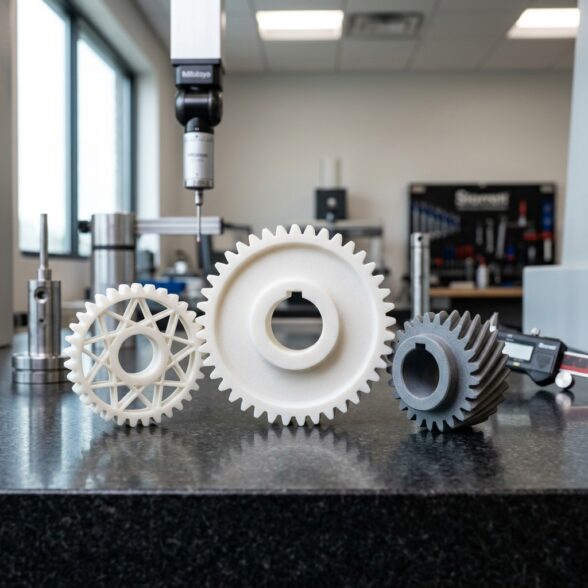
Long confined to prototyping, 3D printing now produces functional gears able to transmit torque over time. Selective laser sintering (SLS) produces gearwheels, racks and worm gears with enough accuracy for general mechanical engineering.
- Plastic damps vibration: a PA12 gear is markedly quieter than a steel-on-steel pair.
- PA11 has a low coefficient of friction.
- The inertia of the drive train can be reduced with hollowed pinions or open lattice webs.
- Our design office sizes the tooth profile upstream (DfAM).
Tribological materials (friction)
| Material | Use | Advantage |
|---|---|---|
| PA12 (polyamide) | General purpose | Good balance between sliding and mechanical strength. Economical. |
| Bio-based PA11 | Fatigue | Better impact and cyclic fatigue resistance than PA12. |
| PA3200 GF (glass-filled PA12) | High load | Stiffer, handles more torque, but more abrasive for the mating part. |
Common applications
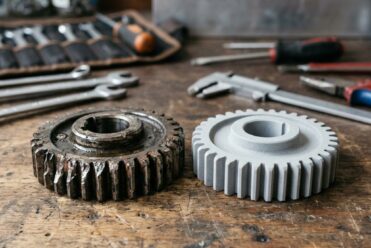
Replacement pinions
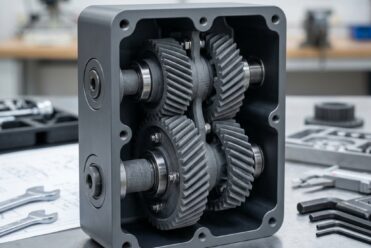
Custom gearboxes
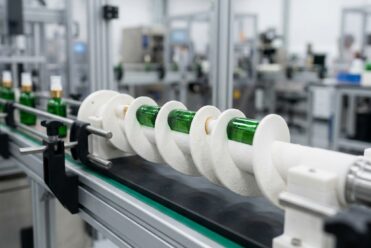
Conveying
Frequently asked questions
In standard SLS we recommend a minimum module of 0.8 to 1. Below that, tooth definition may become imprecise. For micro gears (module under 0.5), we steer projects towards injection in a prototype mold or micro-machining.
Lower in theory, but often sufficient. A properly sized plastic gear (tooth calculation) can run for millions of cycles. It often acts as a mechanical fuse, protecting the motor if the mechanism jams.
We can print the shaft profile directly (D-cut, splines) or provide a housing for a hexagonal metal insert or a key, so the torque is transmitted without crushing the plastic.
PA12 gears (SLS) ship within 4 to 6 working days.
Let’s discuss your project
Related applications
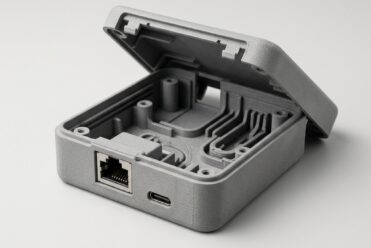
Electronic enclosures and covers