


Ergonomic Handles and Custom Grips
Fitting the tool to the person
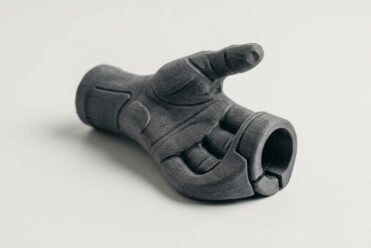
In industry, standard tools force the operator to adapt to the machine. 3D printing reverses that logic: the tool adapts to the person. We scan the imprint of the hand to create anatomic handles.
- An optimal grip reduces the clamping force required and the muscular fatigue that goes with it.
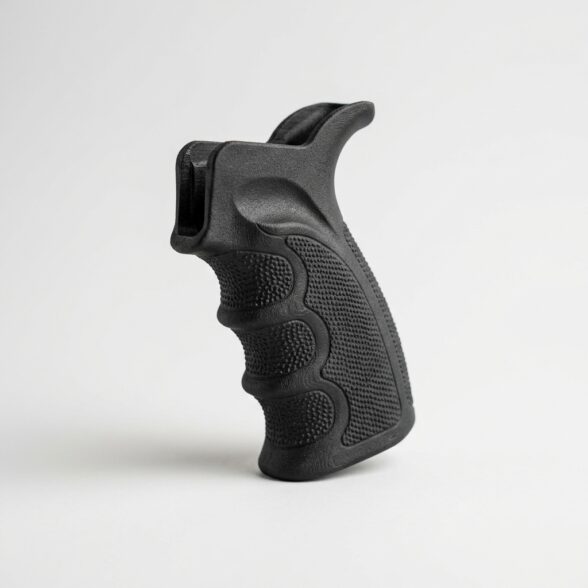
- 3D printed surface textures (studs, ribs) stop the tool from slipping, even with greasy gloves.
- One-off customization means printing a left-handed and a right-handed version, or an S, M and L size for each operator, with no additional tooling cost.
Materials: balancing stiffness and comfort
| Handle area | Material | Why? |
|---|---|---|
| Core (structure) | PA12 / PA3200 GF (glass-filled) | Maximum stiffness to transmit force without bending. |
| Skin (contact) | TPU / flexible PU | Vibration damping and non-slip grip. |
| Texture | Modelled texture | Built directly into the CAD file (studs, ridges) to increase grip without post-processing. |
Common applications
Hand tools
Control levers
Sport and disability
Frequently asked questions
We use a portable 3D scanner (Scan 3D Flex offer) to digitize your hand in the gripping position, on clay or foam. The resulting 3D file serves as a negative to model the matching handle, through our 3D scanning and reverse engineering service.
In vacuum casting, we can overmold an elastomer grip onto a rigid insert. In 3D printing, we can mechanically assemble two shells or use PolyJet (digital materials) to vary the Shore hardness.
PA12 (nylon) offers a good compromise between stiffness and impact resistance. For extreme use we recommend a wall thickness of 3 to 4 mm, or a solid part.
For use with gloves, a diamond or ribbed texture is recommended. For bare hands, a bead-blasted or lightly grained surface is more comfortable.
Let’s discuss your project
Related applications
Buttons, keypads and HMI controls