


Functional Prototypes and Mechanical Testing
The crash test before the injection tool
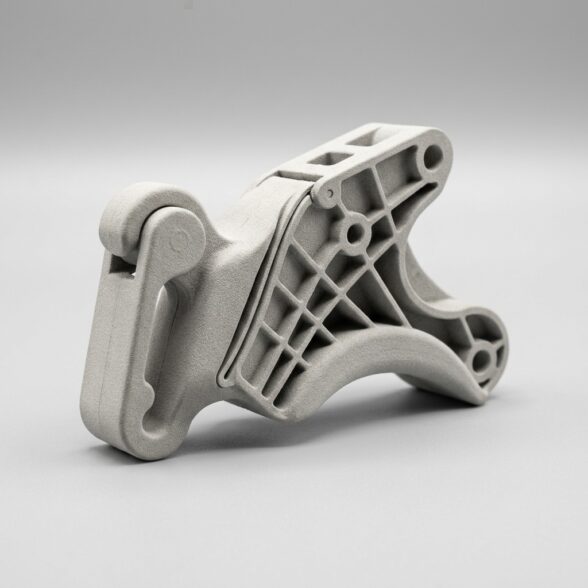
A functional prototype has to behave as closely as possible to the future production part. We use engineering thermoplastics (PA12, PP, PA11) to produce parts that can take real loads.
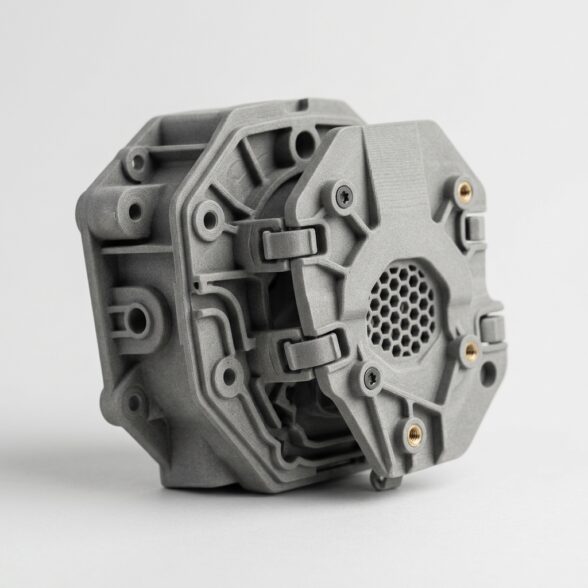
- Assembly validation checks the clip fits, the screw joints and the interferences between components.
- Thermal testing qualifies parts destined for hot environments, such as under-bonnet applications or locations close to a heat source (PA3200 GF, ULTEM 9085 or PC in FDM).
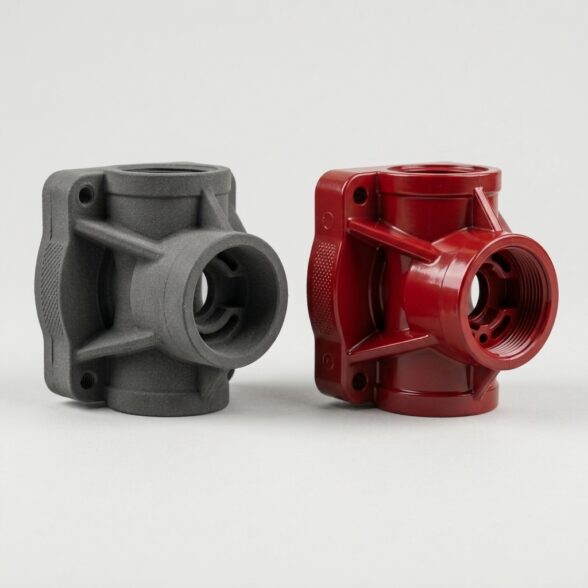
- Leak testing validates fluid circuits, with resin impregnation to improve sealing.
Validation materials (close to production)
| Prototype material | Close to | Properties |
|---|---|---|
| PA12 (SLS) | ABS / PA6 | The standard. Balanced, robust, slightly flexible. For housings, clips. |
| Glass-filled PA12 (PA3200 GF) | PA6-GF30 | Stiff, resistant to temperature and load. For structural parts. |
| PP01 (SLS) | Polypropylene | Good chemical resistance, good fatigue behaviour (hinges). |
| TPU | Rubber | Flexible, elastic. For seals, bellows, dampers. |
From prototype to production
The advantage of powder technologies (SLS/MJF) is that they use materials very close to injection molding. If your mechanical tests on the SLS prototype pass, that is a good indication that the molded part will hold up. For a final validation in the production material, we move to the aluminium prototype mold, which allows the real thermoplastic to be injected.
What can be tested on a functional prototype?
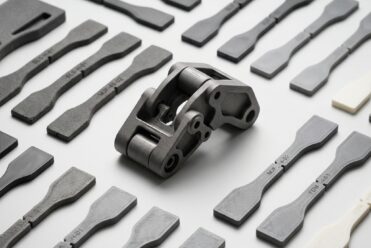
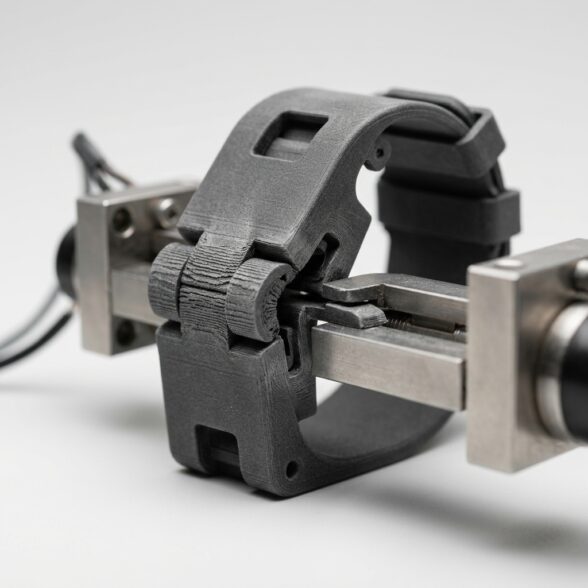
A functional prototype puts the part in its real situation before any tooling is committed. Assembly tests check clips, screw joints and clearances between components. Fatigue tests reproduce thousands of opening or bending cycles, in particular on living hinges in PP or PA12. Leak tests validate a fluid circuit after resin impregnation. Heat, UV and chemical resistance tests qualify the part for its real environment. For standardized, traceable measurements, we produce characterization test specimens under the same printing conditions as the part.
Designing for function (DfAM)
The success of a functional prototype is decided at the design stage. A clip in PA12 SLS needs a fillet radius to avoid a crack initiation point, a living hinge is oriented along the layers to take the bending, and a wall thickness of 1.5 to 2 mm delivers stiffness without excess weight. Our design office adapts the geometry to the rules of additive manufacturing before the build starts, which avoids rework and breakages during testing.
Frequently asked questions
We recommend SLS (powder) or MJF for functional prototypes. Nylon has the elasticity needed to deform without breaking when the clip engages.
We hold ± 0.25 mm in SLS (NFT 58000 class, category 3), depending on the geometry. For sliding or interference fits (H7/g6), we recommend leaving extra stock and machining the final fit after printing.
PA12 SLS has excellent resistance to cyclic fatigue. For standardized tests (ISO 527, ISO 178), we produce test specimens under the same conditions as your future parts.
SLS prototypes ship within 4 to 6 working days. Allow slightly longer for MJF. Mechanical testing (characterization report) adds a further 3 to 5 days.
SLS and MJF produce nearly isotropic, robust parts close to injection molding, ideal for a representative mechanical test. FDM suits an economical shape validation but stays anisotropic and more fragile between layers. As soon as load or cycling is involved, we steer projects towards SLS or MJF.
Let’s discuss your project
Related applications
Visual and appearance prototypes
Large format XXL prototypes